

Last Updated: October 23, 2026
Quick Summary
Virtual nursing clinical training builds clinical judgment through screen-based simulation, live remote instruction, and structured online coursework before nurses touch a patient. Research shows virtual simulation improves clinical reasoning and supports knowledge and skills acquisition, making it effective for repeatable practice, standardized assessment, and flexible blended learning.
- Assign the same scenario twice, two weeks apart, and compare the action log.
- Build 10 minutes of guided debrief into every 20-minute scenario.
- Virtual platforms score against fixed rubrics so every nurse faces the same bar.
- A three-month, 72-hour online education intervention improved evidence-based practice competence.
- Pick three metrics before launch: scenario score, time-to-correct-action, and competency sign-off rate.
Table of Contents
- Why Virtual Nursing Clinical Training Benefits Matter Now
- Benefit 1: Repeatable Practice Without Patient Risk
- Benefit 2: Stronger Clinical Reasoning and Judgment
- Benefit 3: Virtual Nursing Simulation for Hard-to-Staff Skills
- Benefit 4: Consistent Nursing Clinical Skills Assessment
- Benefit 5: Blended Learning for Nurses Fits Real Schedules
- Benefit 6: Measurable Outcomes for Clinical Managers
- Where Virtual Nursing Clinical Training Falls Short
- Frequently Asked Questions
Why Virtual Nursing Clinical Training Benefits Matter Now
Virtual nursing clinical training is the use of screen-based simulation, live remote instruction, and structured online coursework to build hands-on clinical judgment before a nurse ever touches a patient. A systematic review published in PubMed Central found that virtual simulation can improve clinical reasoning and works as an effective approach to knowledge and skills acquisition (systematic review on virtual simulation and clinical reasoning(https://pmc.ncbi.nlm.nih.gov/articles/PMC9212904/)). That finding matters to every clinical manager in Killeen, TX who is short on preceptors and long on open shifts.
At Eminent Healthcare Resources, we build live, virtual, and group training for EDs, EMS agencies, and health systems. Below, we break down the seven gains that show up again and again, plus the limits nobody warns you about.
Benefit 1: Repeatable Practice Without Patient Risk
The first gain is simple: nurses can practice the same scenario ten times without a single patient in the room. Wolters Kluwer describes screen-based virtual simulation as a way for nursing students to practice clinical judgment in a low-stakes, repeatable environment (EXTERNAL_LINK: Wolters Kluwer on screen-based virtual simulation | wolterskluwer.com). In practice, that means a new grad can run a deteriorating-patient scenario until the recognition pattern sticks.
A common mistake is treating repetition as busywork. It isn’t. Reps build the reflex that shows up at 3 a.m. when nobody is coaching.
Assign the same scenario twice, two weeks apart, and compare the action log. The gap between run one and run two tells you more than any quiz score.
Benefit 2: Stronger Clinical Reasoning and Judgment
Clinical reasoning improves when learners get structured feedback on decisions, not just on final answers. Research published in PubMed Central found that virtual simulation technologies benefit student learning when integrated into clinical nursing education (study on virtual clinical learning in nursing education(https://pmc.ncbi.nlm.nih.gov/articles/PMC12004849/)). The key word is integrated. Bolting a module onto orientation and calling it done does little.
What most guides miss is that reasoning grows from debriefs. Build 10 minutes of guided debrief into every 20-minute scenario and watch triage calls sharpen.
Benefit 3: Virtual Nursing Simulation for Hard-to-Staff Skills
Virtual nursing simulation solves a staffing problem as much as a learning problem. A 2025 article reports that VR simulations give student nurses repeated practice of technical skills, including sterile skills (EXTERNAL_LINK: J. Thrift on virtual reality in the nursing workforce | ncbi.nlm.nih.gov). Sterile technique, rapid response drills, and low-frequency high-risk events are exactly the skills that go rusty between real cases.
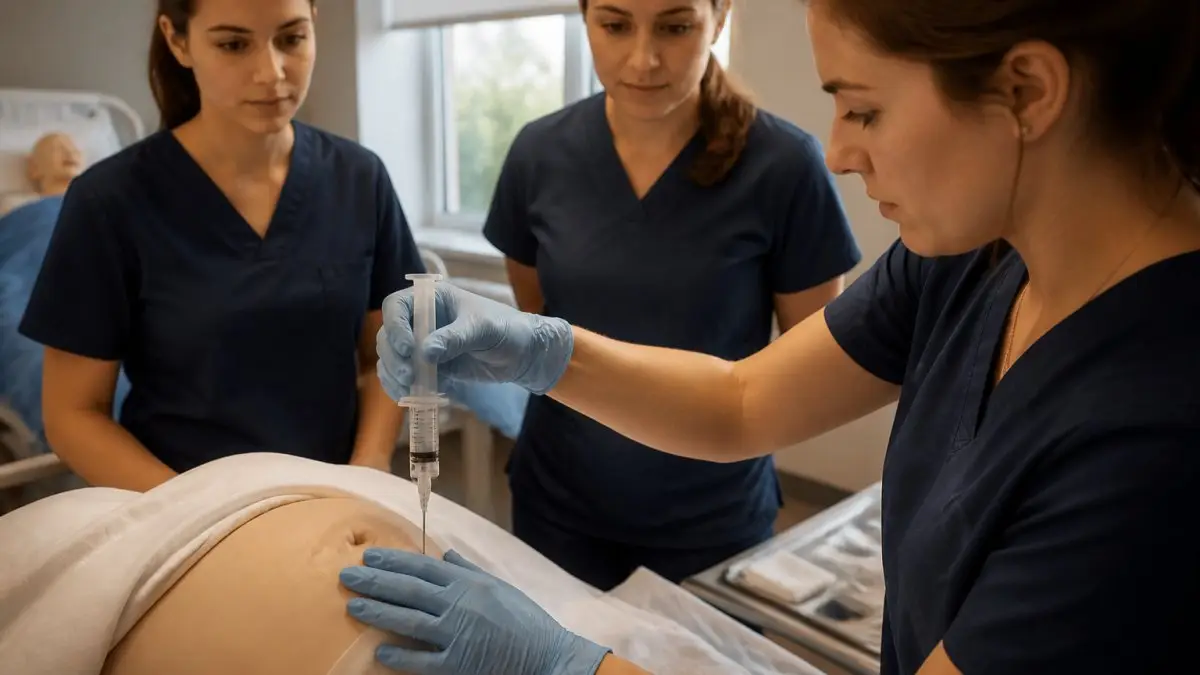
For EMS crews running prehospital protocols, the win is the same: rehearse the rare call until it feels routine.
Benefit 4: Consistent Nursing Clinical Skills Assessment
A nursing clinical skills assessment only means something if every nurse faces the same bar. Virtual platforms score against fixed rubrics, so a night-shift nurse in one unit and a day-shift nurse in another get judged identically.
Compare the two approaches:
| Assessment Method | Consistency | Feedback Speed | Best For |
|---|---|---|---|
| Live preceptor observation | Varies by preceptor | Same shift | Hands-on procedures |
| Virtual scenario scoring | Fixed rubric | Immediate | Judgment and triage |
| Written exam | High | Days | Knowledge recall |
| Blended (virtual + live) | High | Same week | Full competency sign-off |
Blended learning for nurses pairs the two strongest rows. Use virtual scoring for judgment, live sign-off for hands-on technique.
Benefit 5: Blended Learning for Nurses Fits Real Schedules
Scheduling is where most training plans die. Blended learning for nurses splits content into short virtual sessions plus scheduled live practice, so staff can complete modules between shifts instead of losing a full day.
One study found that a three-month, 72-hour online education intervention improved competence in evidence-based practice (Ramos-Morcillo et al. on online training and evidence-based practice(https://pmc.ncbi.nlm.nih.gov/articles/PMC11566661/)). That’s a real time commitment, but it’s spread out, not crammed into one exhausting week.
Don’t stack virtual modules onto an already full shift. Nurses who train after a 12-hour shift retain far less, and your completion numbers will look fine while competence doesn’t move.
Benefit 6: Measurable Outcomes for Clinical Managers
Managers need numbers they can take to a budget meeting. Virtual delivery produces them: completion rates, scenario scores, time-to-decision, and repeat-attempt trends. Research also shows a positive shift in nursing students’ intention to engage in evidence-based practice after virtual education (EXTERNAL_LINK: Falahati-Marvast et al. on virtual training and evidence-based practice intention | ncbi.nlm.nih.gov).
We tie every course to those outcomes so a clinical manager can show what changed, not just what was assigned.
Pick three metrics before you launch: scenario score, time-to-correct-action, and competency sign-off rate. Everything else is noise.
Where Virtual Nursing Clinical Training Falls Short
Virtual training has real limits, and pretending otherwise costs you credibility with staff. It cannot replace hands-on technique checks, and it cannot teach the feel of a difficult airway or a combative patient.
What it does well is prepare the brain before the hands arrive. Use virtual nursing clinical training for judgment, repetition, and standardization. Use live sign-off for physical skill.
If you’re searching for a training partner, ask three questions: Do you offer live and group options? Can you show outcome data? Do you understand prehospital protocols? Eminent Healthcare Resources answers all three, with AHA and ENA certification courses, TNCC and ENPC provider training, and CEN review built for teams.
Frequently Asked Questions
What are the benefits of virtual nursing clinical training?
Virtual nursing clinical training gives learners repeatable, low-stakes practice with clinical judgment, which a 2022 systematic review in PubMed Central found can improve clinical reasoning and support knowledge and skills acquisition. A 2025 study in PubMed Central reported that virtual simulation technologies benefit student learning when integrated into clinical nursing education. Programs also support standardized skills assessment and blended learning for nurses, so staff can practice on their own schedule while educators track progress across a unit or system.
Can virtual nursing simulation improve clinical skills?
Yes. A 2025 article by J. Thrift reports that VR simulations give student nurses opportunities for repeated practice of technical skills, including sterile skills. Wolters Kluwer describes screen-based virtual simulation as a way to practice clinical judgment in a low-stakes, repeatable environment. The gains come from repetition and feedback, not from the screen alone, so pair simulation with a debrief and a skills check before signing off competency.
How can nurse educators assess clinical competency virtually?
Use a nursing clinical skills assessment built around observed scenarios and structured rubrics. Learners work through screen-based cases while educators score decision points, communication, and technique against set criteria. A 2024 study by A. J. Ramos-Morcillo and coauthors found that a three-month, 72-hour online education intervention improved competence in evidence-based practice, which shows that structured online programs can move competence, not just knowledge. Keep a skills checklist for hands-on tasks that still require in-person verification.
How should hospitals combine virtual and in-person nursing training?
Use blended learning for nurses: deliver the knowledge and case-reasoning portions online, then reserve in-person time for hands-on skills, sterile technique, and team drills. A 2025 study by F. Falahati-Marvast and coauthors reported a positive change in undergraduate nursing students’ intention to engage in evidence-based practice after virtual education. That makes online modules a strong front end for certification prep, with in-person sessions confirming technique before staff work independently.
Clinical training budgets are tight, and preceptor time is tighter. Eminent Healthcare Resources delivers evidence-based, standardized education through live, virtual, and group formats, with measurable outcomes your leadership can review. Our expert-led review courses and certification prep keep teams career-ready without pulling them off the floor for a week. Get started with Eminent Healthcare Resources and build a training plan that fits your shifts, your protocols, and your budget.
