

Last Updated: October 26, 2026
Quick Summary
Scalable emergency department training solutions deliver the same clinical standard to 10 nurses or 300 without rebuilding the curriculum each time. They combine standardized content, flexible delivery, and consistent assessment so competency means the same thing in every department.
- Four delivery models dominate emergency care education: in-person, live virtual, hybrid, and simulation-based.
- Build onboarding checklists in four tiers, keeping Tier 1 and Tier 2 items identical across every site.
- Justify certification budgets around turnover cost avoided, competency gaps closed, and scheduling disruption reduced.
- Run short, frequent simulation scenarios on real unit layouts instead of treating simulation as an annual event.
- Choose a training partner on standardized curriculum, delivery flexibility, competency validation, outcome reporting, and scheduling support.
Table of Contents
- What Scalable Emergency Department Training Actually Means
- The Four Types of Emergency Department Training Solutions
- Building an Emergency Department Onboarding Checklist That Scales
- How to Justify an Emergency Nursing Certification Budget
- Where Emergency Department Simulation Training Fits
- The Case for Virtual Training for Emergency Nurses
- Criteria for Choosing a Training Partner Your System Can Scale
- Planning Your Next Certification Cohort With Eminent Healthcare Resources
- Frequently Asked Questions
What Scalable Emergency Department Training Actually Means
Scalable emergency department training solutions are programs that deliver the same clinical standard to 10 nurses or 300 without rebuilding the curriculum each time. The definition matters because most ED leaders confuse “scalable” with “online.” A course can be virtual and still collapse under its own logistics.
At Eminent Healthcare Resources, we work with EDs, EMS agencies, and health systems, and the pattern is consistent: the training that scales is the training that standardizes content, delivery, and assessment together.
Three components decide whether a program scales:
- Standardized content so every cohort receives identical clinical instruction
- Flexible delivery so nights, weekends, and multi-site teams can all complete it
- Consistent assessment so competency means the same thing in every department
Miss any one of those and you get what most systems already have: a training program that works beautifully in one department and falls apart in the next.
The Four Types of Emergency Department Training Solutions
Four delivery models dominate emergency care education, and each scales differently. The right mix depends on your headcount, shift structure, and how much hands-on competency your accreditation requires.
| Delivery Type | Scales Well Because | Main Constraint | Best For |
|---|---|---|---|
| In-person instructor-led | Expert instruction, immediate feedback | Instructor and room availability | Small cohorts, hands-on certification |
| Live virtual | No travel, repeatable scheduling | Screen-based skill limits | Multi-site systems, didactic content |
| Hybrid | Combines reach with hands-on checks | Coordination overhead | Certification prep plus skills validation |
| Simulation-based | Repeatable, low-resource practice | Equipment and facilitator time | High-acuity scenario training |
In-Person Instructor-Led Courses
In-person courses remain the benchmark for hands-on certification, but they scale linearly: more nurses means more instructors, more rooms, more dates. The World Health Organization’s Basic Emergency Care course, for example, is traditionally taught in person over five days, which illustrates the scheduling burden a single cohort can create (WHO Basic Emergency Care course structure). In-person delivery works best for skills that genuinely require a body in the room.
Live Virtual and Hybrid Delivery
Live virtual delivery removes travel and lets one expert instructor reach multiple sites at once. Hybrid models pair that reach with scheduled in-person skills validation. The trade-off is real: virtual sessions handle didactic content and case discussion well, but psychomotor competency still needs a hands-on check somewhere in the pipeline.
Simulation and Scenario-Based Practice
Simulation lets teams rehearse high-acuity events repeatedly without patient risk. A 2025 review in Frontiers in Disaster and Emergency Medicine describes extended-reality technologies as a potentially cost-effective, scalable alternative to traditional emergency medical services training because they allow repeated practice (2025 review of extended-reality training). That repeatability is the whole point: teams practice the same scenario until the response is automatic.
Building an Emergency Department Onboarding Checklist That Scales
An emergency department onboarding checklist scales when it separates what every nurse must prove from what varies by unit. Build it in four tiers:
- Tier 1: System-wide requirements (BLS, ACLS, HIPAA, documentation)
- Tier 2: ED core competencies (triage, resuscitation support, medication safety)
- Tier 3: Unit-specific skills (trauma bay, pediatric bay, behavioral health)
- Tier 4: Competency validation with a signed assessor check per item
The mistake we see most often is a checklist built for one department and copy-pasted everywhere. A scalable onboarding checklist uses identical Tier 1 and Tier 2 items across every site, then lets each unit add Tier 3 items without touching the core. That way a nurse transferring between departments arrives with a verifiable record, not a stack of site-specific paperwork.
How to Justify an Emergency Nursing Certification Budget
Justifying an emergency nursing certification budget comes down to framing it as retention and compliance spending, not a perk. Certification prep supports clinical confidence, and confident nurses stay. The 2026 EMS workforce study from Workforce Solutions documents recruitment and retention pressure across emergency services, including declining volunteerism and rising training requirements (2026 EMS workforce study).
Build the justification around three lines: turnover cost avoided, competency gaps closed, and scheduling disruption reduced by choosing a delivery format that fits your shifts. For a deeper walkthrough of the numbers and the argument structure, see our guide on how to justify a nursing certification budget.
Where Emergency Department Simulation Training Fits
Emergency department simulation training fits where textbook knowledge and real-patient performance diverge: resuscitation, rapid triage, and team communication under pressure. A dual-site study of simulation-based training for emergency department flow management described the approach as scalable and low-resource, suitable for repeated training, multidisciplinary exercises, and inter-hospital competitions (dual-site simulation training study).
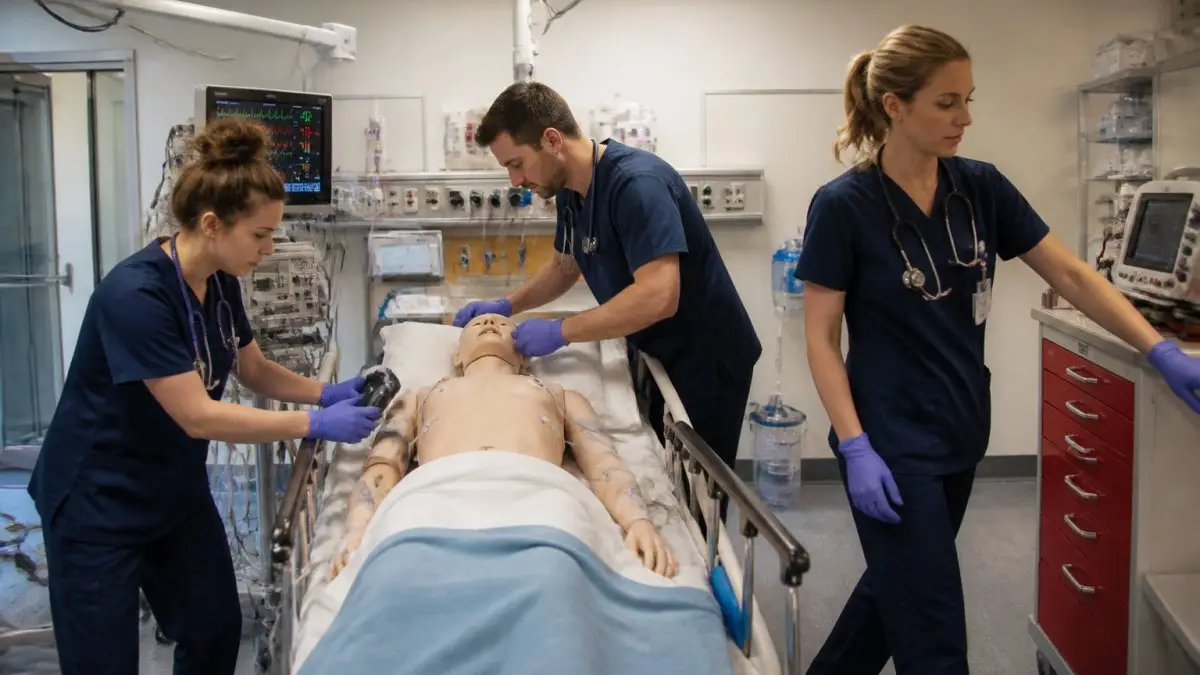
What most programs get wrong is treating simulation as an annual event. Run short, frequent scenarios on real unit layouts and the training starts changing how teams actually behave during a real code.
The Case for Virtual Training for Emergency Nurses
Virtual training for emergency nurses works best as the didactic backbone of a blended program. Live virtual sessions deliver consistent content to every shift and every site without pulling staff off the floor for travel days. The constraint is honest: virtual delivery cannot validate hands-on skill on its own, so pair it with scheduled in-person competency checks.
For systems running multiple EDs, that combination is what makes a single curriculum feasible. Our breakdown of virtual nursing clinical training benefits covers the concrete gains in more detail.
Criteria for Choosing a Training Partner Your System Can Scale
Choose a training partner on five criteria, in this order: standardized curriculum, delivery flexibility, competency validation, outcome reporting, and scheduling support. A partner that nails the first two but skips outcome reporting leaves you unable to prove the investment worked.
Watch out: the most common failure is a partner whose content cannot flex across departments. If the curriculum is locked to one unit’s workflow, standardization becomes a bottleneck instead of an advantage. Ask directly how the content adapts across sites, and ask for the reporting structure you will receive after each cohort. The delivery infrastructure built for healthcare education shows the delivery infrastructure to evaluate against those criteria.
Planning Your Next Certification Cohort With Eminent Healthcare Resources
Planning a cohort starts with three inputs: headcount by site, shift coverage constraints, and the certification targets for the year. From there, the delivery mix follows: live virtual for didactic content, in-person or simulation for skills validation, and group scheduling that keeps units staffed.
Eminent Healthcare Resources delivers expert-led board review, clinical certifications, and leadership preparation through scalable, standardized training for EDs, EMS agencies, and health systems. Our live, virtual, and group formats support AHA and ENA certifications, including TNCC and ENPC provider courses and CEN review. If you are comparing options for your team, contact us to discuss scheduling and formats, or reserve courses for your next cohort directly.
Frequently Asked Questions
What training should emergency department staff receive?
At minimum, ED staff need current basic and advanced life support certification, trauma and pediatric emergency courses such as TNCC and ENPC, and ongoing competency checks on high-risk skills. Board certification preparation for CEN, CPEN, or TCRN strengthens clinical depth. A scalable emergency department training program bundles these into a predictable calendar so certifications do not lapse and new hires reach competency on a fixed timeline rather than whenever an instructor is free.
How can hospitals scale training across emergency department shifts?
The practical fix is mixing delivery formats. Live virtual sessions cover didactic content for night-shift staff who cannot leave the floor, while in-person and simulation blocks handle hands-on skills. Standardized curricula and shared completion tracking let managers run multiple cohorts in parallel across units. That combination removes the single-instructor bottleneck that stalls most multi-site rollouts.
How do you measure the effectiveness of emergency department training?
Track certification pass rates, time-to-competency for new hires, completion rates by unit and shift, and refresher lapse rates. Pair those with simulation performance scores and periodic skills validation. A review of extended-reality training notes that repeated practice is a core advantage of scalable formats, which makes repeat assessment a realistic measurement tool rather than a one-time event.
What is the difference between emergency department training and simulation training?
General ED training covers knowledge and certification content: life support, trauma nursing, pediatric emergency care, and board review. Emergency department simulation training adds hands-on scenario practice, such as a dual-site study of ED flow management that used simulation for multidisciplinary exercises and repeated team drills. Simulation is a delivery method inside a broader training program, not a replacement for it.
How can a hospital justify its nursing certification budget?
Frame the request around retention and compliance rather than education as a perk. Workforce studies document recruitment and retention pressure across emergency services, including rising training requirements. Tie spend to measurable outputs: pass rates, vacancy fill speed, and reduced agency reliance. Then compare cost per clinician across delivery formats and ask providers for group pricing, since rates depend on cohort size, dates, and delivery mode.
How can emergency departments standardize training across multiple locations?
Standardization requires one curriculum, one assessment standard, and one reporting view. Choose a provider that delivers the same content in live, virtual, and group formats so a rural site and a flagship hospital sit on the same syllabus. Require completion dashboards by site, and audit a sample of simulation scores each quarter to confirm the standard holds in practice, not just on paper.
The challenge is rarely finding training content. It is delivering the same standard of training to every nurse, on every shift, at every site, without burning out your educators. Eminent Healthcare Resources builds that structure for you with standardized curricula, live and virtual group delivery, and outcome reporting your leadership can act on. Get started with Eminent Healthcare Resources and give your next cohort a training program that holds together at scale.
