

Last Updated: November 1, 2026
Quick Summary
EMS trauma care training programs are structured courses that teach prehospital providers how to recognize, assess, and manage traumatic injuries before the patient reaches a hospital. They combine hands-on skills, scene judgment, and documentation habits, and trauma content scales with each of the four EMS licensure levels.
- Trauma-related incidents accounted for 18.6% of EMS workload in 2025, up from 17.9% in 2023.
- The 2021 National EMS Education Standards define four EMS licensure levels, from EMR to paramedic.
- EMT courses typically run weeks to a few months, while paramedic training takes a year or more.
- TNCC is nurse-focused and does not replace a prehospital trauma course built for EMS scope.
- Before enrolling, confirm accreditation, request a per-clinician quote, and check for scenario-based learning.
Table of Contents
- What EMS Trauma Care Training Programs Actually Cover
- Texas EMS Certification Requirements Before You Train
- EMT vs Paramedic: Paramedic Training in Central Texas
- EMS Trauma Assessment Training: What Good Programs Teach
- TNCC Certification: Who It Is For and How It Fits EMS
- How to Choose a Program: Accreditation, Cost, and Curriculum
- Book a Group Training Consultation for Your Agency
- Frequently Asked Questions
What EMS Trauma Care Training Programs Actually Cover
Trauma-related incidents accounted for 18.6% of EMS workload in 2025, up from 17.9% in 2023, according to the ImageTrend 2026 EMS Insights Report. That jump matters for anyone weighing EMS trauma care training programs in Killeen, TX and beyond. More trauma calls means more demand for crews who can assess, stabilize, and transport injured patients under pressure.
Eminent Healthcare Resources delivers expert-led trauma and resuscitation training for EDs, EMS agencies, and health systems. Here is the short version: EMS trauma care training programs are structured courses that teach prehospital providers how to recognize, assess, and manage traumatic injuries before the patient reaches a hospital.
They go far beyond basic first aid. Good programs combine hands-on skills, scene judgment, and the documentation habits that hold up in a trauma system.
The Four Licensure Levels and Where Trauma Fits
The 2021 National EMS Education Standards define four levels of EMS licensure, including emergency medical responder (EMR) and emergency medical technician (EMT), per the National Highway Traffic Safety Administration. Trauma content scales with each level.
- EMR: bleeding control, airway basics, and spinal precautions
- EMT: full trauma assessment, splinting, and transport decisions
- Advanced levels: IV access, medication, and airway management
- All levels: scene safety and handoff reporting
The takeaway: match the course to the license you hold or plan to hold. Training above your scope wastes time. Training below it leaves gaps.
Texas EMS Certification Requirements Before You Train
Before you enroll anywhere, confirm your certification path. Texas EMS certification requirements start with the state health department’s credentialing process, and most training programs are built to feed into it. The Texas Department of State Health Services oversees EMS certification and trauma system work in the state.
A few practical points to check before you pay for a course:
- Does the program prepare you for a specific license level?
- Is the course tied to a state-approved curriculum?
- Does it include a clinical or field rotation?
- Will the certificate count toward your continuing education hours?
Watch out: some short courses market themselves as “certification” when they are really continuing education. They can still be worth your time, but they will not replace a licensure pathway.
EMT vs Paramedic: Paramedic Training in Central Texas
EMT and paramedic training are not the same ladder rung. EMT is the entry point. Paramedic is the advanced level, with deeper training in airway management, medications, and trauma resuscitation.
Paramedic training is generally a longer course than an EMT course, and paramedics take on more advanced clinical responsibilities in the field.
Here is how the two compare for trauma work:
| Factor | EMT | Paramedic |
|---|---|---|
| Typical course length | Weeks to a few months | A year or more |
| Trauma role | Assess, stabilize, transport | Advanced airway, meds, lead care |
| Skills focus | Bleeding control, splinting, CPR | IV access, drug therapy, complex assessment |
| Best for | New providers, volunteer crews | Career providers, high-volume agencies |
If you are weighing which path fits your agency’s needs, start with call volume and response expectations. A rural crew with long transport times often benefits from more advanced providers on shift.
EMS Trauma Assessment Training: What Good Programs Teach
EMS trauma assessment training is the core skill set that separates a confident provider from a nervous one. It teaches a repeatable system for finding injuries fast and acting on them.
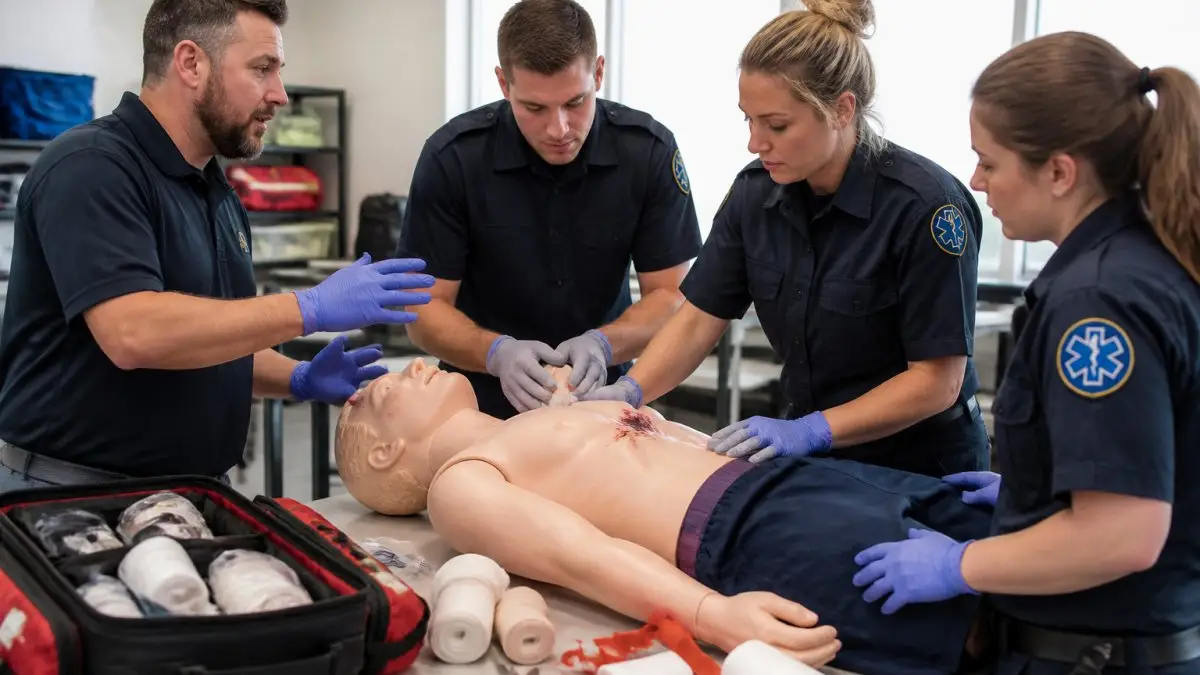
Strong programs drill the same sequence until it becomes automatic:
- Primary survey: airway, breathing, circulation, disability, exposure
- Rapid head-to-toe scan for hidden injuries
- Vital signs and trending
- Splinting, wound packing, and tourniquet use
- Handoff reporting to the trauma team
What most guides miss is the repetition. One demonstration is not training. Providers need repeated scenarios with feedback until the sequence holds under stress.
A 2022 systematic review in peer-reviewed emergency medicine research described trauma-informed care as a framework to reduce the negative health effects of trauma. That lens belongs in assessment training too, not just in hospital settings.
If you want a structured path into trauma certification, explore our trauma nursing certification courses to see how the curriculum builds.
TNCC Certification: Who It Is For and How It Fits EMS
TNCC certification is the Trauma Nursing Core Course, a program built for nurses who care for trauma patients. It is not an EMS license, but it pairs well with prehospital work.
EMS crews hand off to trauma nurses. When both sides speak the same assessment language, handoffs get faster and safer. That is the real value of TNCC for an agency.
Who benefits most:
- ED nurses in trauma-receiving hospitals
- EMS providers who want deeper trauma knowledge
- Clinical educators building cross-training programs
- Nurses pursuing trauma credentials
If you are comparing credentials, our TCRN vs TNCC comparison breaks down the differences. And if you want to teach the course inside your own agency, our TNCC Instructor Course prepares you to deliver it.
One honest limitation: TNCC is nurse-focused. EMTs and paramedics gain useful knowledge from it, but it does not replace a prehospital trauma course built for their scope.
How to Choose a Program: Accreditation, Cost, and Curriculum
Choosing well comes down to three checks: accreditation, cost, and curriculum fit. Get these right and most other decisions fall into place.
Accreditation. Confirm the course is recognized by a credible body. The National Association of Emergency Medical Technicians offers trauma education built for EMS practitioners, which gives you a benchmark for quality.
Cost. Pricing depends on quantity, dates, and delivery format. Ask for a per-clinician quote and compare it to your current spend. Do not assume the cheapest option saves money if it skips hands-on practice.
Curriculum. Look for scenario-based learning, skills labs, and feedback. A 2014 study in BMC Medical Education on paramedic trauma training noted that further multicenter studies were still needed, which tells you the evidence base keeps evolving. Ask providers how they measure outcomes.
Questions to Ask Before You Sign Up
Bring this checklist to every provider conversation:
- Is the course accredited, and by whom?
- What is the pass rate, and can you show outcome data?
- How much hands-on practice is included?
- Does the content fit EMS protocols, not just hospital workflow?
- What is the cost per clinician for a group?
- Can training be scheduled around shift coverage?
- What continuing education credit does it carry?
If you need CPR prerequisites sorted first, check our BLS Provider Course details. For logistics like cards and course requirements, our frequently asked questions page covers the common ones.
Book a Group Training Consultation for Your Agency
Choosing trauma training comes down to fit. Your agency needs training that matches its protocols, its schedule, and its budget.
That is where we come in. Eminent Healthcare Resources delivers expert-led trauma and resuscitation training with live, virtual, and group options, built around standardized delivery to keep crews consistent.
Contact Eminent Healthcare Resources through the website to discuss a trauma training plan for your agency, and request a quote for current pricing.
Frequently Asked Questions
What training do EMS professionals need for trauma care?
Every EMS professional starts with a licensure-level program aligned to the current national and state standards. Trauma care is woven through that education, then deepened with focused courses. Trauma is a regular part of EMS workload, so trauma skills get regular use. Many agencies add trauma assessment training and, for nurses and some prehospital teams, TNCC certification to keep skills current.
What is the difference between EMT and paramedic training?
EMT training is the entry point and covers basic assessment, airway support, bleeding control, and transport. Paramedic training goes further into advanced airway management, medications, and complex trauma decision-making, and it takes substantially longer. Both build on the same national standards, but paramedic programs assume you already hold an EMT credential. When comparing programs, check clinical hours and trauma rotations, since those hours are where assessment skills actually develop.
Is TNCC certification intended for EMS providers or nurses?
TNCC is a trauma nursing course, so it is built around the emergency nurse’s role in hospital trauma bays. EMS providers usually get more value from prehospital-focused trauma assessment training. That said, EMS agencies that transport into trauma centers benefit when their crews understand the same assessment language nurses use. If your team works closely with a hospital trauma program, aligning terminology across both groups reduces handoff confusion.
How can an EMS agency choose trauma training for its team?
Start with accreditation and curriculum alignment to national standards, then confirm the format fits your shift schedules. Ask about group pricing, since rates depend on class size, dates, and delivery method. Request outcome data or pass rates from other agencies, and check whether the content can flex across departments. A short pilot with one crew before a system-wide rollout shows you how the material lands in practice.
