

Last Updated: October 25, 2026
Quick Summary
Evidence based nursing education uses instructional methods grounded in published research rather than tradition or habit, such as active learning, simulation, and messy case studies. A 2024 study found evidence-based practice education improved undergraduate nursing students’ competency, critical thinking, and problem-solving. Evaluate any strategy with a before-and-after measure, not a satisfaction survey.
- Active learning must force retrieval and judgment; if students can sit silent and still pass, it isn’t active.
- A 2026 article identified four approaches to teaching evidence-based practice: collaborative, virtual, teacher-led, and practice-based.
- Structure case studies around three questions: most likely problem, what would change your mind, and next action.
- AACN’s Winter 2026 ACE Spotlight reported 809 participants with a 16% average knowledge increase.
- Set a pretest baseline, define the outcome, and compare results by department, not just as a system average.
Table of Contents
- Evidence-Based Teaching Strategies for Nursing Students That Improve Outcomes
- Active Learning Strategies in Nursing Education: What the Evidence Supports
- Simulation-Based Learning in Nursing Education: From Skills Lab to Clinical Judgment
- Nursing Education Case Study Examples That Build Clinical Reasoning
- How to Evaluate Whether an Evidence Based Nursing Education Strategy Works
- Challenges and Tradeoffs When Scaling Evidence-Based Education
- Building a Standardized Training Plan for Your Team
- Frequently Asked Questions
Evidence-Based Teaching Strategies for Nursing Students That Improve Outcomes
Evidence-based teaching strategies for nursing students are instructional methods grounded in published research rather than tradition or habit. A 2024 study in the International Journal of Environmental Research and Public Health found that evidence-based practice education improved undergraduate nursing students’ competency, critical thinking, and problem-solving (pubmed.ncbi.nlm.nih.gov). Eminent Healthcare Resources builds its certification and board review courses around that same principle: teach what the evidence supports, then measure whether it worked.
Here is the core tension in nursing education right now. A 2020 scoping review reported that two earlier reviews found wide variation in both the content and the implementation of evidence-based teaching. There is no single uniform approach. That’s not a weakness. It’s a map of where to make choices.
Below, we break down seven strategies that hold up under scrutiny, plus how to check whether they’re working on your unit.
Active Learning Strategies in Nursing Education: What the Evidence Supports
Active learning means students do something with the material instead of listening to it. The scoping review in BMC Medical Education catalogued the teaching strategies used to build evidence-based practice knowledge and skills in undergraduate nursing, and discussion, problem-solving, and applied practice recur throughout.
What works in practice:
- Case-based discussion before lecture content
- Peer teaching, where students explain a concept to each other
- Short written appraisals of a research article, done in class
- Rapid-fire clinical decision drills with immediate feedback
A common mistake is calling any group activity “active learning.” If students can sit silent and still pass, it isn’t active. The evidence favors methods that force retrieval and judgment.
Simulation-Based Learning in Nursing Education: From Skills Lab to Clinical Judgment
Simulation-based learning in nursing education moves students from isolated skills to whole-scenario judgment. A 2026 article by P. Jokiranta and coauthors identified four approaches to teaching evidence-based practice in nurse education: collaborative, virtual, teacher-led, and practice-based methods. Simulation sits at the intersection of all four.
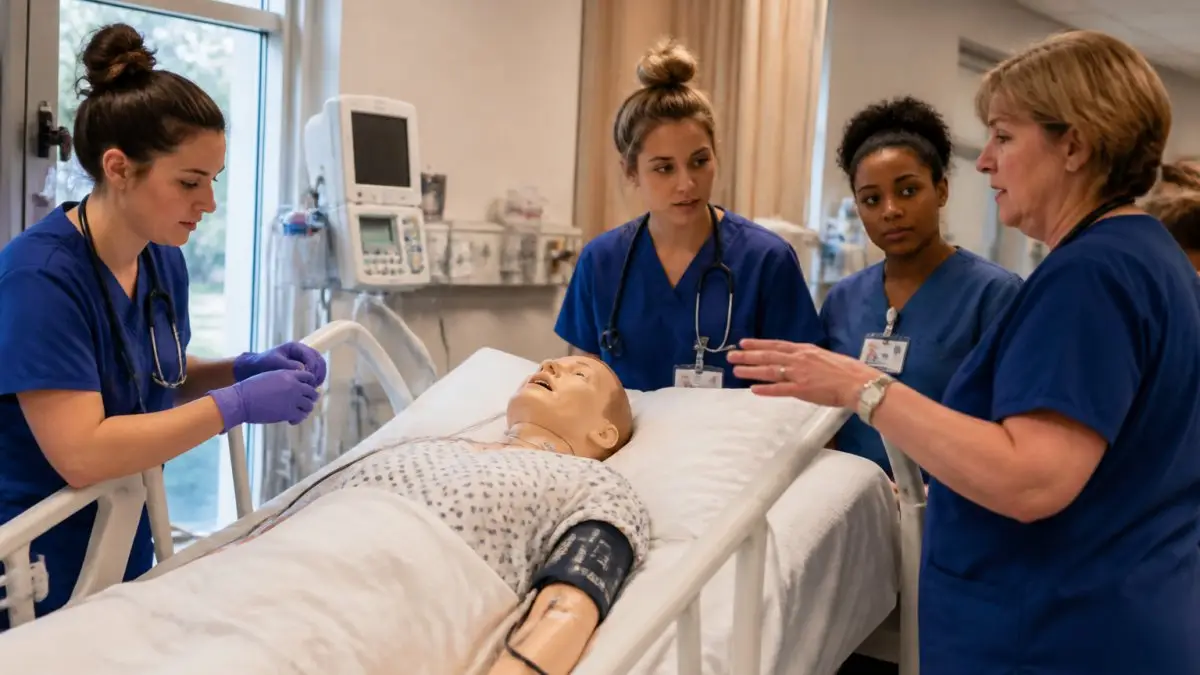
The distinction that matters: a skills lab teaches a task. A simulation teaches a decision under pressure. Teams use simulation to rehearse deteriorating-patient calls before they happen for real.
If you’re weighing virtual options, you can explore virtual nursing simulation or read about the benefits of virtual clinical training.
Nursing Education Case Study Examples That Build Clinical Reasoning
Case studies build reasoning when they’re messy. Real patients don’t present in tidy textbook order, and the strongest nursing education case study examples include distractors, incomplete histories, and changing vitals.
Structure a case study around three questions:
- What is the most likely problem, and what evidence supports it?
- What would change your mind?
- What is your next action, and why now?
The American Association of Colleges of Nursing reported in its Winter 2026 ACE Spotlight that 809 participants completed a program with a 16% average knowledge increase, up from a 67.47 average pretest score. That’s the kind of pre/post measurement a good case study program should generate.
How to Evaluate Whether an Evidence Based Nursing Education Strategy Works
Evaluating an evidence based nursing education strategy requires a before-and-after measure, not a satisfaction survey. Learners rating a course highly tells you it was pleasant. It doesn’t tell you they can perform.
Use this checklist:
- Set a pretest baseline before instruction begins
- Define the outcome: knowledge score, skill check, or board pass rate
- Measure the same thing after instruction, with the same tool
- Compare against a control group or prior cohort
- Review results by department, not just as a system average
Watch out: a post-test that reuses pretest questions measures recall of those questions, not competence. Change the items or the scenario.
Challenges and Tradeoffs When Scaling Evidence-Based Education
Scaling evidence-based education across a health system means accepting tradeoffs. The 2020 scoping review’s finding of variation in content and implementation is the central challenge: what works in one department may not fit another.
The real tensions:
- Consistency vs. flexibility. Standardized content ensures every clinician gets the same baseline. It also can’t flex for an EMS agency’s prehospital protocols versus an ED’s.
- Cost vs. depth. Shorter sessions fit busy schedules but cut practice time.
- Measurement vs. speed. Rigorous evaluation takes longer than a smile sheet.
The National League for Nursing lists generating and translating innovative teaching and learning approaches among its 2024-2027 research priorities. That’s an acknowledgment that scale is still an open problem, not a solved one.
A healthcare-focused LMS makes the delivery side easier to standardize.
Building a Standardized Training Plan for Your Team
A standardized training plan starts with one question: what must every clinician on this team be able to do? Build backward from that answer.
| Step | What to Do | Frequency |
|---|---|---|
| 1. Define competencies | List required skills per role | Annually |
| 2. Baseline | Pretest every learner | Before training |
| 3. Deliver | Live, virtual, or hybrid sessions | Per schedule |
| 4. Assess | Skills check and post-test | After each module |
| 5. Review | Compare results by department | Quarterly |
Keep the plan short enough that people actually finish it. A five-module plan completed beats a twenty-module plan abandoned in week two.
If you’re ready to standardize across a system, you can bring Eminent training to your team in virtual, or group training formats.
Frequently Asked Questions
What are evidence-based teaching strategies in nursing?
Evidence-based teaching strategies in nursing are instructional methods backed by published research showing they improve learning outcomes. A 2026 article by Jokiranta and coauthors grouped them into four approaches: collaborative, virtual, teacher-led, and practice-based. A 2024 study in the International Journal of Environmental Research and Public Health found that evidence-based practice education improved undergraduate nursing students’ EBP competency, critical thinking, and problem-solving. The point is to choose methods with measurable results rather than tradition.
How can nursing educators teach evidence-based practice effectively?
A 2018 scoping review in BMC Medical Education identified teaching strategies that build evidence-based practice knowledge and skills in undergraduate programs. Start by making EBP a skill students practice, not a lecture topic: have them form a clinical question, search a database, appraise a study, and apply it to a patient scenario. The 2020 scoping review noted that content and implementation vary across programs, so consistency matters. Standardized, repeated practice across a curriculum produces more reliable competency than a single course.
How do you evaluate the effectiveness of a nursing education strategy?
Use pre- and post-test scores plus a competency measure. The American Association of Colleges of Nursing reported a program where 809 participants completed training with an average knowledge increase of 16%, from an average pretest score of 67.47. Pair knowledge gains with observed clinical performance, such as simulation checklists or case-based assessments. Track results by department and cohort so you can see whether the strategy works consistently, not just on average.
How can clinical educators help nurses apply research to patient care?
Make the research usable at the point of care. Use short case study examples drawn from your own unit, run simulation scenarios that require nurses to justify decisions with evidence, and give teams brief debriefs after real events. The 2026 teaching-method review includes practice-based approaches as one of four categories for a reason: application in the clinical setting is where evidence-based nursing education turns into behavior. Leaders should also remove barriers like limited search access and time pressure.
What is the difference between evidence-based practice and evidence-based teaching?
Evidence-based practice is the clinical standard: clinicians combine the best available research with their expertise and patient preferences to make care decisions. Evidence-based teaching is the education standard: educators use research on how people learn to choose instructional methods. The two connect. When nursing programs teach EBP through methods that are themselves evidence-based, students learn the process by experiencing it, which is more likely to carry into practice.
The hard part isn’t finding evidence-based strategies. It’s delivering them consistently across every shift, department, and agency without losing the flexibility each team needs. That’s the problem Eminent Healthcare Resources was built to solve, with expert-led review, live and virtual group training, and standardized delivery that produces measurable outcomes. Get started with Eminent Healthcare Resources and give your team training that holds up when it counts.
